While headline figures suggest a slow advance, the reality for micro and small businesses is one of calculated discipline and persistent hesitation.
The Consumer:
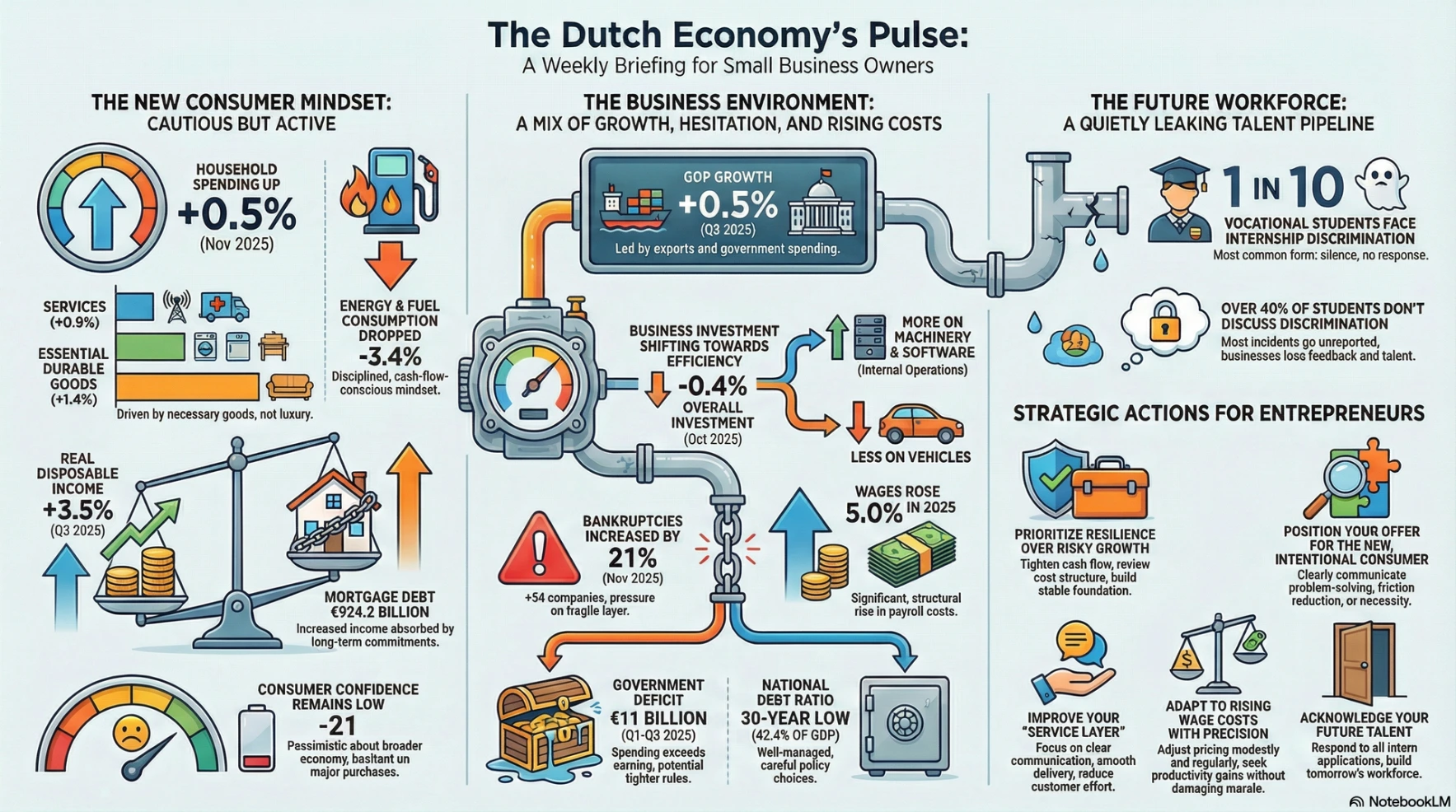
Spending with IntentionIn November 2025, Dutch household consumption rose by 0.5 percent compared to the previous year. While this sounds positive, it is a “ripple” rather than a wave, signifying a shift in where money is flowing.
Consumption is increasingly directed toward services (+0.9%), such as transport, communication, and medical services, and durable goods (+1.4%), specifically clothing and electrical appliances.However, this is not a luxury spending spree; the sources describe it as a “replacement economy” where consumers buy what is necessary to keep life functioning rather than for status.
Meanwhile, spending on "other goods," including energy and fuel, dropped by 3.4 percent, indicating that households are actively cutting volume to compensate for high background costs. This reflects a cautious and disciplined consumer who manages their household like a business owner manages cash flow.
Business Conditions:
Growth Amidst FrictionThe broader economic indicators show that GDP rose by 0.5 percent in the third quarter of 2025, largely driven by exports and government spending. Yet, for the local entrepreneur, this growth often feels “distant”. Several factors contribute to this friction:
Wage Pressures: Collectively negotiated wages rose by 5.0 percent in 2025. While this restores purchasing power for workers, it represents a structural shift in cost bases for small employers who must now decide whether to absorb these costs or risk raising prices.
Investment Hesitation: Investments in tangible fixed assets fell by 0.4 percent in October 2025. Businesses are specifically delaying the replacement of transport fleets (trucks and vans) while continuing to invest in machinery and software that improve immediate operational efficiency.
Fragility: Bankruptcies saw a 21 percent increase in November 2025 compared to October, suggesting that the "fragile layer" of the economy is under significant pressure.The Government FactorThe Dutch government is currently spending more than it earns, with a deficit of €11 billion in the first three quarters of 2025. While the debt ratio remains the lowest in 30 years at 42.4% of GDP, the growing deficit signals a future shift toward more selective subsidies, tighter tax rules, and increased compliance expectations for small businesses.
Strategic Takeaways for the WeekFor the micro-entrepreneur, the sources suggest that 2026 rewards precision over ambition.
1. Enhance the Service Layer: Even if you sell products, reduce customer effort through better communication and predictable delivery, as convenience is now a deciding factor for cautious spenders.
2. Shorten Planning Cycles: Do not wait for a return to "old" behaviours; instead, plan in shorter cycles and focus on improving resilience rather than chasing growth at any cost.
3. Maintain Cash Discipline: Treat the current deficit and market hesitation as a "weather system." Strengthen your financial buffers and monitor client payment behaviours closely to avoid cash flow disruptions.
The Dutch consumer is still active, and the economic engine is running, but confidence remains fragile.
The most successful businesses will be those that respect the customer’s need for certainty and adapt their operations to a market that is selective rather than chaotic.